


MOZA HMA150 Review Roundup: 3DOF Motion, Setup and Verdict
Featured review: SuperChicane — Test du système dynamique MOZA HMA150 : L’excellence presque abordable
The French Simracer verdict in 30 seconds
The MOZA HMA150 Motion System makes four-actuator 3DOF motion easier to install and configure than many specialist alternatives. TFS listed the complete kit at €3,199.90 when checked on 30 July 2026. Its hardware offers substantial speed, travel and payload headroom, while reviewers consistently praise its immersion once settings are restrained. The compromises are equally clear: it requires a rigid aluminium-profile cockpit, careful screen and cable planning, and software that was still evolving during launch testing. It is an immersion upgrade for an already mature setup, not a guaranteed route to faster lap times.
How this article was built: TFS has not presented the HMA150 as an in-house driving test here. This is an editorial synthesis of the current TFS listing, MOZA’s live technical pages, specialist coverage from Traxion, OC Racing and Simracing-PC, plus the four YouTube reviews embedded on the product page. Driving observations remain attributed to their respective creators.
What is the MOZA HMA150 Motion System?
The MOZA HMA150 is a complete four-actuator motion kit designed to retrofit a compatible aluminium-profile sim rig. The four actuators reproduce three degrees of freedom: pitch for forward and rearward tilt, roll for side-to-side movement and heave for vertical displacement.
This distinction matters. A 3DOF platform can recreate chassis attitude, suspension movement, kerbs, bumps, compressions and a convincing suggestion of acceleration or braking through tilt. It cannot sustain the continuous longitudinal or lateral acceleration of a real car. Simracing-PC correctly frames motion as a way to persuade the brain with coordinated movement rather than reproduce every real-world G-force literally.
Pitch, roll and heave for the complete cockpit.
Large travel and speed headroom, even though racing profiles rarely need the maximum.
Payload capability depends on the selected speed and acceleration mode.
Current official specification for additional cockpit texture.

MOZA HMA150 specifications: what is currently confirmed?
| Specification | Current official value | Practical meaning |
|---|---|---|
| Movement | Heave ±75 mm, pitch ±7.59°, roll ±12.04° | Three degrees of freedom distributed across four corners. |
| Stroke and speed | 150 mm, up to 300 mm/s | Considerable headroom; believable racing profiles generally use much less travel. |
| Payload | 350 kg maximum for the four-actuator system | MOZA quotes over 1G and 300 mm/s at 250 kg, versus 0.45G and 150 mm/s at 350 kg. |
| Vibration | 0–200 Hz | Adds engine, kerb, ABS, wheel-slip and surface effects through the rig. |
| Control | 21-bit magnetic encoder, 600 MHz processor | Position sensing and real-time actuator control; these figures do not replace a driving assessment. |
| Power architecture | 110–220V AC input, converted to 48V DC; 1500W rated | Integrated actuator controllers avoid four external industrial servo drives. |
You may still encounter 150 Hz in early launch videos and product copy. MOZA’s live specification page now states 0–200 Hz; this article uses that current manufacturer value, checked on 30 July 2026. Likewise, launch coverage frequently quotes an 8 ms response, while the current detailed page uses the broader wording “millisecond-level response”.
Installation: the cockpit matters as much as the actuators
The HMA150 is not a self-contained cockpit. It raises and moves an existing rig, so the structure must be rigid enough to accept the forces without flexing or resonating. TFS currently lists compatibility with European-standard aluminium profiles. Tubular cockpits are not presented as supported.
When is the optional profile adapter required?
The standard brackets suit profiles with usable adjacent grooves. For 40120 or 40160 profiles with a closed central rail, the MOZA HMA Profile Adapter Kit may be required. Inside Sim Racing and Simracing-PC both encountered this distinction during installation. Check the rail geometry before ordering rather than assuming every aluminium rig mounts identically.
Cables, power supply and ground clearance
Reviewers generally describe mechanical installation and calibration as straightforward, but the complete system still demands planning. The power supply is large, cables must remain clear when the platform lowers, and the cockpit needs enough clearance at maximum pitch and roll. OC Racing reported a cable-routing lesson after a lead was pinched during shutdown, while Simracing-PC recommends manually testing each movement before driving.
Should the monitor move with the cockpit?
This is one of the clearest practical warnings across the videos. Inside Sim Racing found a rig-mounted screen difficult to focus on in Assetto Corsa Rally and preferred a detached display or VR. SuperChicane warned that the HMA150’s fine, fast vibrations could be hard on a large screen mounted directly to the moving cockpit. A separate monitor stand is therefore the safer default unless the screen support has been engineered for motion.
How does the MOZA HMA150 feel according to specialist tests?
Circuit driving: weight transfer, braking and road detail
SuperChicane used an iRacing MX-5 at Brands Hatch and a BMW M4 GT3 at Spa. The review describes convincing differences between the softer movement of the MX-5 and the firmer GT3 suspension response, with useful information about rear grip, braking, track vibration and chassis load. WallStark similarly highlights synchronized weight transfer and the way the platform distinguishes car movement from steering feedback.
OC Racing reaches a more measured conclusion after several months of ownership: the actuators feel fast and natural once tuned, but the aggressive default profiles initially exaggerated pitch, roll and kerb impacts. Reducing movement made braking, elevation and weight transfer more believable.
Rally and large suspension events
Rally is where the 150 mm stroke becomes easiest to understand. WallStark reports the compression, rebound, jumps, road texture and wheel slip in Assetto Corsa Rally as the most demonstrative use case. SuperChicane also praises rally immersion, while warning that the same high-frequency movement increases stress on a cockpit-mounted display.
Are the integrated haptics a replacement for pedal motors or bass shakers?
Not necessarily. MOZA uses the 0–200 Hz bandwidth for effects such as engine vibration, ABS, traction control, gear shifts, wheel slip and road detail. OC Racing nevertheless found the integrated haptics less clearly differentiated than dedicated pedal motors, bass shakers or a seat-based system. The safest conclusion is to view them as an additional whole-rig texture layer, not a guaranteed replacement for localized feedback.
Noise and neighbours
MOZA’s laboratory figures state no more than 55 dB at one metre under maximum speed and acceleration, and no more than 58 dB with official racing presets. Real rooms add floor-borne vibration. Simracing-PC recommends anti-vibration material and warns that unrestricted use in an apartment depends heavily on the building. Race Beyond Matter also notes that the actuators themselves are quiet, while generated impacts and vibrations can still travel through the structure. Several reviewers received or discussed a quieter revised power supply.
MOZA Motion Manager: accessible, but still decisive
Motion Manager handles actuator assignment, cockpit dimensions, calibration, firmware, game profiles and individual motion or haptic effects. SuperChicane found the connect-calibrate-drive process notably easy, and Simracing-PC praised the guided setup and profile management.
The software is also the HMA150’s main first-generation question. Race Beyond Matter considered the hardware highly capable but wanted more mature washout, longitudinal balance and self-levelling behaviour at launch. OC Racing found the stock profiles too dramatic. Other videos show that MOZA was already adding game presets and responding quickly to feedback. These accounts are not contradictory: the interface can be accessible while the underlying motion algorithms and presets continue to mature.
Setting advice: start with the Soft preset or low motion values, verify cockpit and screen clearance, then increase one effect at a time. Maximum stroke is not the target. The most consistent reviews favour restrained pitch and roll, enough heave for suspension events, and haptics adjusted separately.
What does AI Motion do?
Native telemetry remains the preferred source for supported simulators. For games without telemetry, AI Motion analyses visuals and audio to trigger scenario-based effects. MOZA currently lists GTA V Enhanced, Cyberpunk 2077 and Red Dead Redemption 2 for AI Motion. Inside Sim Racing demonstrated the setup and reported a graphics-related problem with Vulkan while DirectX worked during its test. Treat AI Motion as an expanding supplementary mode, not proof that every unsupported title will behave like a telemetry-native simulator.
Which games were actually covered?
The source videos do not all use the same titles. Their observations should therefore remain separate:
- SuperChicane: iRacing with the MX-5 at Brands Hatch and a BMW M4 GT3 at Spa, plus rally driving and broader comparisons with previously tested motion systems.
- WallStark: Le Mans Ultimate in LMP2, drifting in Assetto Corsa and Assetto Corsa Rally.
- Inside Sim Racing: supported telemetry titles and an AI Motion demonstration; the reviewer also discusses Assetto Corsa Rally and monitor behaviour.
- Race Beyond Matter: a detailed motion-tuning and hardware comparison against more expensive specialist systems.
MOZA’s current native-telemetry list includes Assetto Corsa, ACC, Assetto Corsa EVO, Assetto Corsa Rally, iRacing, Le Mans Ultimate, EA SPORTS WRC, DiRT Rally 2.0, Automobilista 2, RaceRoom, BeamNG.drive, F1 23–25, Forza Motorsport and several other titles. Support changes through software updates, so the live Motion Manager list remains the final reference.
The system is currently a PC product. The HMA150 is marketed for racing and flight simulation, but the current TFS listing still describes flight-title support as planned. If flight simulation is your primary use, verify the precise titles and effects currently available before purchase.
What do the four videos on the TFS product page contribute?
 SuperChicane
Long independent French review: setup, software, iRacing, GT3, rally, competitors and screen warning.
Watch the review
 Race Beyond Matter
Hardware and software analysis against higher-priced Qubic-class motion, with detailed tuning criticism.
Watch the review
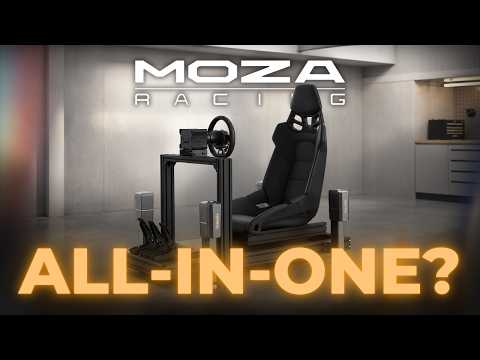 Inside Sim Racing
Installation, included hardware, Motion Manager, AI Motion and attached-versus-detached monitor experience. Product supplied by MOZA; the channel also sells MOZA products.
Watch the showcase
 WallStark
French hands-on driving in LMU, Assetto Corsa and Assetto Corsa Rally, with game profiles and a revised quieter power supply.
Watch the video
Price and value: competitive does not mean inexpensive
The MOZA HMA150 was listed by TFS at €3,199.90 when checked on 30 July 2026. That is a large budget and can exceed the cost of an entire conventional rig. Its value argument only makes sense inside the expensive four-actuator motion category, where several specialist alternatives cost substantially more.
Price alone does not eliminate the need for a suitable cockpit, separate monitor support, possible profile adapters and vibration control. Conversely, the integrated controllers, guided software and complete four-actuator package reduce the DIY work normally associated with motion.
Strengths supported by the sources
- Fast, smooth four-actuator motion with substantial headroom
- Clean architecture without four external industrial servo drives
- Guided calibration and increasingly useful game presets
- Convincing weight transfer, suspension and rally immersion when tuned
- Competitive positioning within premium motion systems
Compromises to consider
- Requires a rigid compatible cockpit and careful screen planning
- Launch software and default profiles still needed refinement
- Whole-rig haptics may not replace localized tactile systems
- Floor-borne vibration remains possible despite quiet actuators
- First-generation reliability and long-term support still need time to prove themselves
Who should choose the MOZA HMA150?
The HMA150 is coherent for a PC sim racer who already owns a rigid aluminium-profile cockpit, has resolved pedals, steering and display ergonomics, and now wants a major increase in immersion. It is especially persuasive for rally, elevation-heavy circuits, casual driving and VR, where chassis movement adds information that a wheel and pedal set cannot reproduce alone.
It is less coherent for a first setup, a flexible or tubular cockpit, a console-only installation, a room where structure-borne noise is unacceptable, or a driver whose only target is lap-time consistency. Competitive drivers may prefer a restrained profile or a static rig. Buyers who prioritise maximum motion refinement over value should also compare established specialist systems, while accepting their higher cost.
TFS editorial verdict: the MOZA HMA150 appears to be one of the most accessible routes into a complete premium 3DOF platform, not because it is inexpensive, but because it combines strong hardware, a comparatively clean installation and a consumer-oriented software path. The early reviews also agree on the main condition: its potential is unlocked through calibration and conservative tuning, not by running every slider at maximum.
Check your cockpit before choosing the HMA150
Confirm profile geometry, total moving mass, screen clearance and cable routing before ordering. The optional adapter is only required for specific closed-rail profiles.
Compatible accessory and related collections
- MOZA HMA Profile Adapter Kit — for specified 40120/40160 closed-centre profiles
- Motion Simulator collection
- MOZA Racing ecosystem
MOZA HMA150 FAQ
Is the MOZA HMA150 a 3DOF or 6DOF system?
The launch kit is a four-actuator 3DOF system providing pitch, roll and heave. The controller and software indicate future expansion, but do not buy the current kit as if an unreleased 6DOF configuration were already available.
What cockpit does the HMA150 require?
TFS currently specifies a rigid aluminium-profile rig. Closed-centre 40120 or 40160 profiles may require the dedicated adapter. Tubular cockpits are not currently listed as supported.
Does the MOZA HMA150 work on PlayStation or Xbox?
No console support is currently confirmed. The system requires a PC and MOZA Motion Manager.
Does the HMA150 make you faster?
Not automatically. Reviewers primarily describe it as an immersion upgrade. Extra movement can even reduce repeatability when settings are too aggressive, so competitive profiles should remain restrained.
Is 150 mm of travel useful for SimRacing?
It provides generous headroom for jumps, elevation and future flight use, but normal racing profiles generally need much less. More travel is not automatically more realistic.
Can AI Motion replace native telemetry?
No. MOZA presents AI Motion as a complement for games without telemetry. Native telemetry remains preferable for physics-driven effects in supported simulators.
Sources checked on 30 July 2026: current TFS product and accessory listings; MOZA HMA150 product and technical pages; Traxion launch coverage; OC Racing long-term review; Simracing-PC review; and the four creator videos linked above. MOZA supplied products to several reviewers; disclosures and observed limitations have been retained.